
How smart energy alternatives halved this strata community’s bills
Philip Cross is a numbers man with a keen eye for the value of a dollar. These attributes helped deliver big savings for his Robina townhouse community as well as himself. Here, Philip, a retired Executive Manager of Market Risk Management for Westpac, shares 7 Tips to Cutting Your Community’s Power Bills.
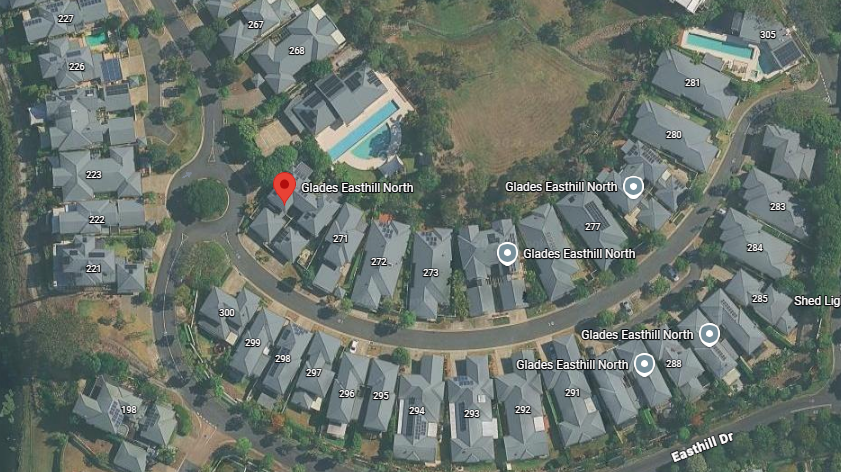
An aerial view of part of the strata complex, showing the solar panels installed on the community centre, next to the pool
I’m part of an 80-home community with good recreation facilities but powering these can chew through electricity – and dollars. However, when your home is governed by a body corporate, moving to smart solar energy must be tackled on two fronts: the technology and your neighbours. Both can be challenging.
In early 2019, soon after I’d arrived here, I joined the Body Corporate (BC) Committee. Given my background, I was happy to take on the role of Treasurer. I’ve been a keen follower of solar, and indeed of energy alternatives, for 50 years so it seemed to me an obvious potential money saver for the community.
I hope these 7 Tips inspire your own journey – and help you navigate it.
Tip No. 1: Identify fellow smart energy advocates
It’s far easier to make improvements when other owners are already excited about the possibilities of making the switch, or are at least open-minded about it. It also helps having a range of personalities to win over fellow owners. And when the goal is saving money, that certainly helps buy-in.
Tip No. 2: Follow the money
If your aim is to cut your energy bills, you need a detailed understanding of where your money is going now. For us, that meant knowing energy use in various areas of the recreation centre.
Our community has a 25-metre heated lap pool, spa, steam room and air-conditioned gym. Additionally, these all need year-round maintenance plus other expenses such as the ever-increasing cost of insurance.
We bought a monitor that tracked consumption and told us precisely what was costing what. Armed with that data, we could drill down and make the best decisions.
The outcome: Our BC energy bill plunged from $30,000 in the year to March 2019 to less than $14,000 in the latest year.
And we’re on track for our bill to be much the same this year.
Tip No. 3: Communicate, communicate, communicate
This is when you need your advocates. A vital early step was ensuring most of our residents would support our new initiatives, given that these would cost money upfront but deliver the benefit of lower running costs in the longer-term.
Change can be difficult for many people and some owners feared we wouldn’t recover our outlay. We worked hard to ensure everyone was kept in the loop. We provided budgets, projections and updates and it was wonderful to see how residents became invested in the plans.
Tip No. 4: Low hanging fruit – tackle the existing systems first
The existing cheap-at-the-time pool pumps proved unsuitable for the pool size and we needed more to run the system hygienically. With several fixed-speed pumps failing – and costing a lot to repair – a group of owners investigated our real requirements.
The upshot: we replaced the old pumps and plumbing with four commercial grade variable-speed pumps that paid for themselves in energy savings within six months. Our energy bill was heading lower.
Next, gas prices were not only increasing significantly but were negating our new savings. We replaced the five-year old gas heater with an electric heat pump.
While that meant a significant investment, the pump was largely paid for by savings generated by the new pool pumps. In turn, the new heat pump created its own running cost savings.
This new equipment, plus the monitor, enabled us to run the overall system more efficiently. The heat pump shuts at mid-evening and restarts early morning. The extra startup power usage is less than running the heater at 2am in mid-winter.
Tip No. 5: You don’t have to do it all at once
It is only in the past two years that we installed solar panels. Their purpose was not to feed the generated energy into the grid but mainly to run our pumps and heaters. Only then do we export excess.
Recently we had days where the solar generation was over 100 kWh and higher than the energy consumed. However, we had to export about 40 kWh as excess during the day only to import it back from the grid currently at more than 10 times the price for nighttime usage.
Naturally, we are actively investigating battery solutions but need to fit it in with the bigger priorities of the body corporate.
Tip No. 6: Spread the good news
I’ve being making similar changes at home – and learning to change habits.
I took a longer-term view when I installed solar roof top hot water, solar panels and a battery.
I run my dishwasher and washer during the day to use my generated power first and charge my battery before exporting excess. Some days I only use my own power. And I have never used the backup grid energy to heat my water.
Even on days when ‘the sun don’t shine’, my solar panels generate energy.
I enjoy sharing my own success stories with my community (and strangers!) to help encourage them to Get Smarter when it comes to power. You can build a better community too. Our committee, for example, now seems more focused on new energy issues and it always helps when they can see they’re saving dollars.
Tip No. 7: Lessons from Our Journey, a retrospective
Hindsight is a great teacher. Here are some things related to our community’s, or my own, ‘empowering’ journeys which will help with the best decisions when we tackle the next steps.
Save for the best available solution now rather than settle for merely adequate. Understand the limits of the set-up you’re installing. A few extra dollars spent now could well exceed that cost in the longer term.
Remember there will be on-going maintenance.
Ensure the after-sales service or technical help of whoever you choose gets good reviews. Talk to others who have used the product or are happy with their after-sales service. This is another place where Electrify Gold Coast is a great resource.
SUMMARY: Start with a Plan, Keep It Flexible & Keep the Big Picture in Mind
In summary, over the past few years, despite rising energy costs, we have easily passed breakeven in hard dollars following our smarter energy approach.
That’s not the point. A reasoned capital expenditure proposal has created ongoing savings in the short term to ensure we don’t have to forego other important maintenance works. And we can even use some of the savings to cool the pool in summer.
While renewables were always being put forward as the solution, the above proves the benefit of our multi-pronged strategy. We analysed our usage, invested in better equipment at not much more cost, considered other workable, near-term options, and kept everyone comfortable with the longer as well as shorter-term plans.
Electrify Gold Coast has offered great opportunities for me to learn and share my experiences. I’m always happy to share more information about our journey at any of the events Electrify Gold Coast hosts.