
My 86 year old Dad just bought an EV
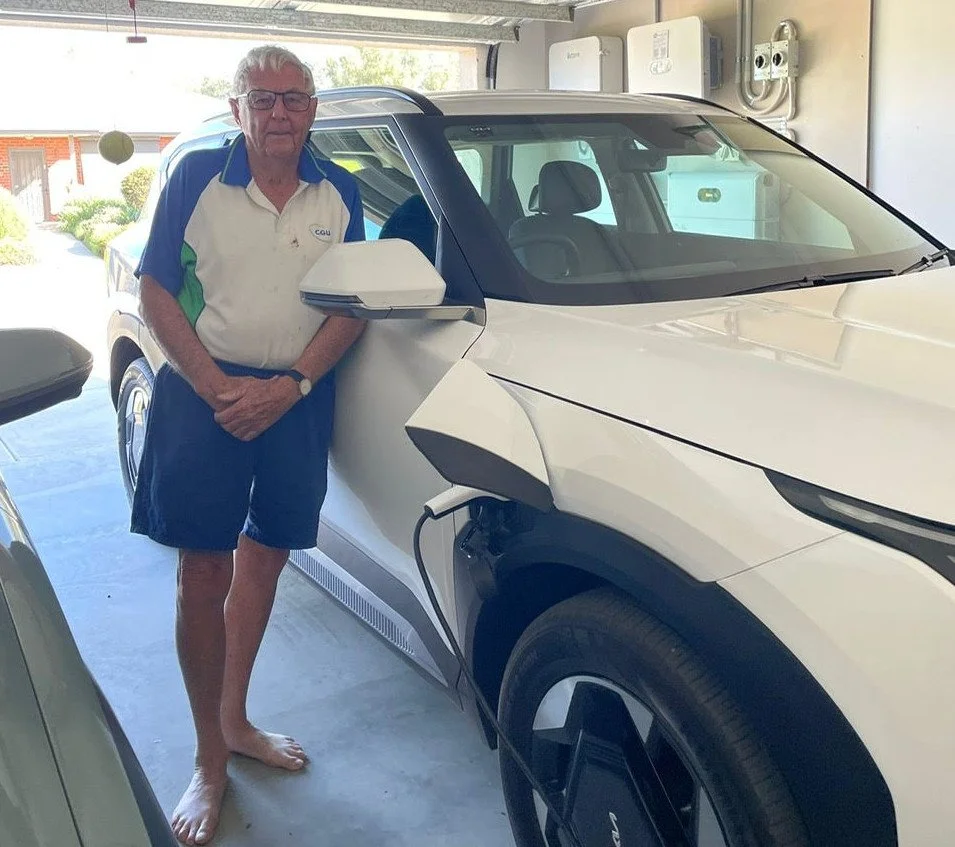
My 86-yo Dad with his new EV, inverter and batteries in the background.
If an 86-year-old retired farmer in rural Australia can drive an electric vehicle (EV), maybe it’s time to rethink what’s possible?
Electric vehicles are often dismissed as something that only work for city people. Too complicated. Too expensive. Not practical in the regions. Fine if you live in the suburbs, close to chargers and shopping centres, but not much use in rural Australia.
And yet, that assumption starts to look pretty shaky when an 86-year-old retired farmer in a small country town makes the switch and gets on with it.
Paying for diesel while exporting energy from rooftop solar makes no sense
My dad is practical, careful with money, and not someone who rushes into new technology. Earlier this year, he admitted he was driving a 50 kilometre round trip to buy diesel in a nearby town because it was 20 cents a litre cheaper than in the small rural town where he lives. At the same time, he had solar panels on the roof exporting plenty of energy to the grid for very little return. So the obvious question was: “Why are you paying for fuel when you are already generating energy at home?”
At first, the answer was not especially enthusiastic. There was a fair bit of grumbling.
From hybrid to full EV
But after a few test drives of EVs and plug-in hybrids, the idea started to seem less far-fetched. We had settled on a BYD Sealion 6 plug-in hybrid as a middle-ground option. It could do 100 km on the battery - enough to get my parents around town and to bowls games. The 1000 km petrol range would work well for their longer trips once or twice a year. Then fuel prices rose sharply during the Iran war-related fuel crisis, and Dad announced that he’d ordered an all electric Kia EV5 - trading in his diesel Kia as part of the deal.
As a retired farmer, he had another reason for changing course. He felt that in a fuel crisis, diesel should be conserved as much as possible for people who genuinely need it most — farmers and truckies, relying on diesel-powered machinery and transport to keep producing food and running essential rural businesses.
So instead of buying another diesel vehicle, he bought a Kia EV5.
And that, really, is the point.
If an 86-year-old retired farmer in rural Australia can make an EV work, then perhaps electric vehicles are not nearly as impractical or intimidating as many people imagine.
Making charging easy
For day-to-day driving, Dad will mostly charge at home. To begin with, he plans to use an ordinary 10 amp power point. That will be enough for many households, especially retirees or anyone doing mostly local trips. Later, he may upgrade to an iStore EV charger to work with his inverter and home battery, but there is no need to do everything at once.
We also got the grandkids involved in setting up the charging apps and ordering RFID cards for the public charging networks - so he can tap and charge. That turned into a nice little family project, but it also made another point clear: this is not beyond ordinary people. It is just something new to learn, like online banking, streaming TV or a smartphone once were.
He tried out public charging in the nearby town - success!
EVs are cheap to own
And the savings when driving an EV are significant.
Instead of burning diesel bought at country service station prices, Dad can now use electricity generated from his own roof. Even when charging from the grid, driving on electricity is usually far cheaper per kilometre than driving on diesel or petrol. When you already have solar, the economics become even more compelling.
This is what often gets missed in the EV debate. People focus on the purchase price, the occasional long trip, or the fear of the unfamiliar. But they overlook the weekly reality of running a car: the constant cost of fuel and maintenance. For households trying to cut living expenses, reducing transport costs can make a real difference.
EVs are great in rural Australia too
Dad lives in the countryNot inner-city Melbourne. Not suburban Brisbane. Not somewhere with chargers on every corner.
A small country town.
That matters because one of the most persistent myths about EVs is that they only work in cities. In reality, many regional drivers are well suited to EV ownership. They often have off-street parking, making home charging easy. They tend to do regular, predictable trips. And many already have solar, which means they can charge from their own roof instead of relying on expensive fuel from the bowser.
Of course, EVs will not be the right fit for every person in every circumstance. Some people tow heavy loads long distances. Some live in rentals without easy access to charging. Some need a different vehicle type for now.
But stories like Dad’s are a useful reminder that the picture is changing.
An 86-year-old retired farmer in rural Australia looked at the numbers, looked at the practicalities, thought about the wider fuel situation, and decided an EV made sense. He will save a heap on running costs, make better use of the solar energy he is already generating, and leave more diesel for the people and industries that still truly depend on it.
Maybe that is not a story about how everyone should rush out and buy an EV tomorrow.
But it is a pretty good example of how electric vehicles are already making sense for more Australians than many people realise.