
From a 17-Year-Old Mazda to a BYD Dolphin
Why one Gold Coast local switched to electric – and hasn’t looked back
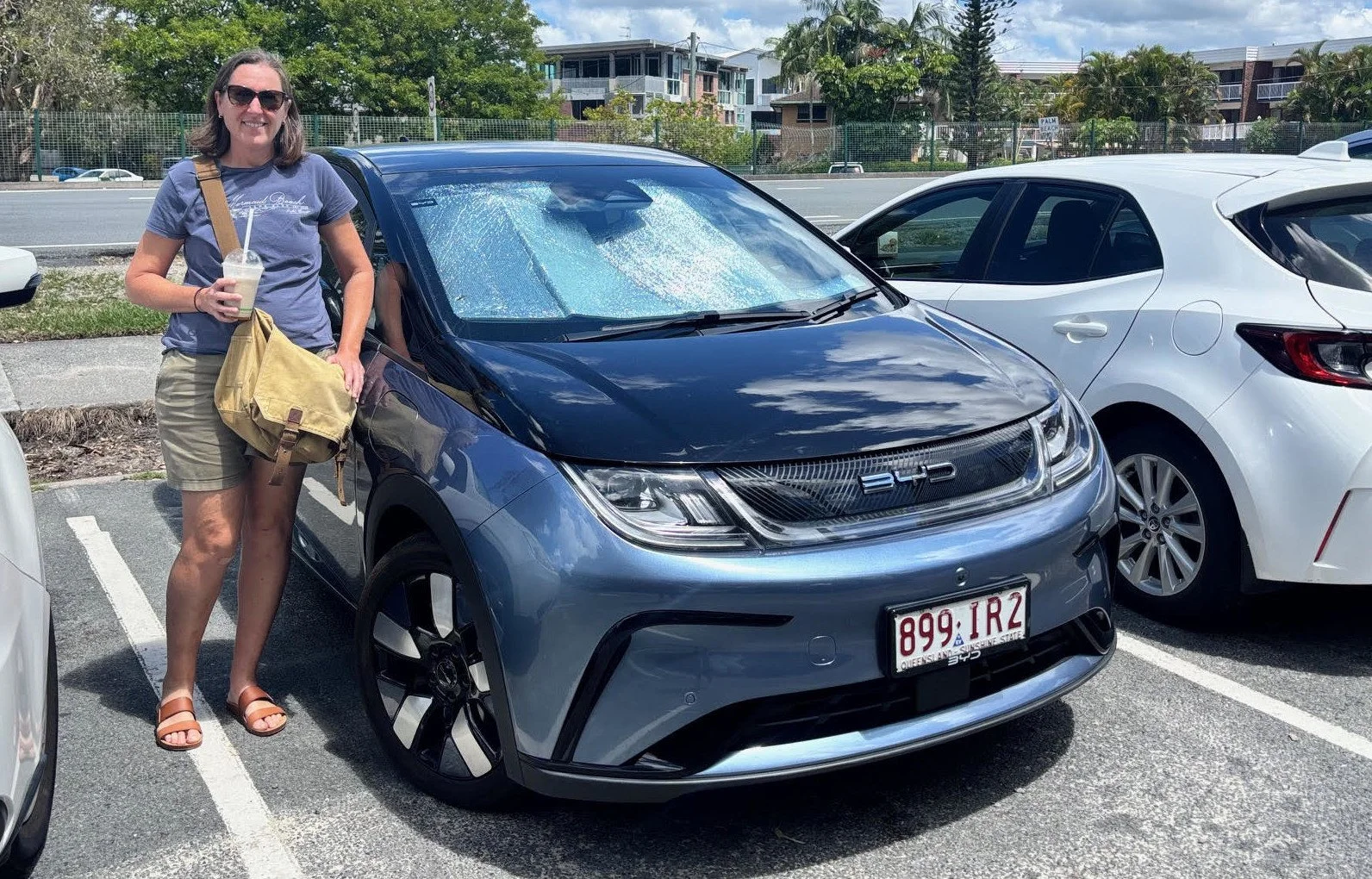
Susan with her BYD Dolphin
In November 2023, Gold Coast resident, Susan, replaced her 17-year-old Mazda 3 with a BYD Dolphin. Susan and her partner are now a fully electric household, using their cars for daily commuting, regional travel, and long road trips into NSW and Victoria.
After owning an EV for two and a half years and driving 27,000 km, her story highlights what EV ownership actually looks like on the Gold Coast – including charging, costs, road trips, and living without a petrol “backup” car.
Why Susan Chose the BYD Dolphin
“I didn’t want a big car – I wanted something practical that was fun to drive.”
When BYD released the Dolphin in Australia, it filled a gap: a compact, affordable EV that still felt comfortable on highways and regional roads.
Susan chose the long-range battery version, not because of day-to-day travel, but due to regular travels west of the Gold Coast where charging infrastructure is thinner.
Susan says the bigger battery gave her peace of mind for regional trips, to places like the Scenic Rim, where chargers aren’t as reliable or spaced further apart.
Driving Feel: Better Than Her Old Manual Mazda
“It’s so smooth. The power is instant.”
Moving from a manual sports version petrol car to an EV felt like a big change – but it didn’t take long to win her over.
Susan loves what the BYD offers:
Smooth, gear-free driving
Strong acceleration for overtaking on single-lane highways
More confidence when passing trucks
Easy switching between Eco and Sport modes depending on the drive
Susan says due to the instant acceleration available, the Dolphin allows her to overtake quickly & confidently making highway driving feel safer.
Charging at Home: No Fancy Charger Needed (At First)
“We didn’t spend any money on chargers to start with.”
For the first year of EV ownership, her household charged mainly from:
A regular outdoor powerpoint
Solar during weekends
Top-ups on road trips at fast chargers
They had the powerpoint checked by an electrician for safety, but didn’t install a wall charger initially.
Her partner commutes 160 km round trip to work each day and only utilised charging from a powerpoint overnight and topping up at work when available. Ironically, her partner works for an oil and petroleum distributor!
This real-world setup shows that you don’t need perfect infrastructure on day one to make EV ownership work.
They recently installed a SigEnergy bi-directional EV charger which allows for charging the car with more excess solar as well as accommodate the usage of the car’s battery to power the house when this functionality is approved by the regulator and BYD. This could be done now however it would void the battery’s warranty.
Road Trips: Yes, You Can Drive to Sydney, Canberra and Beyond
“I wanted to know for myself what it’s actually like.”
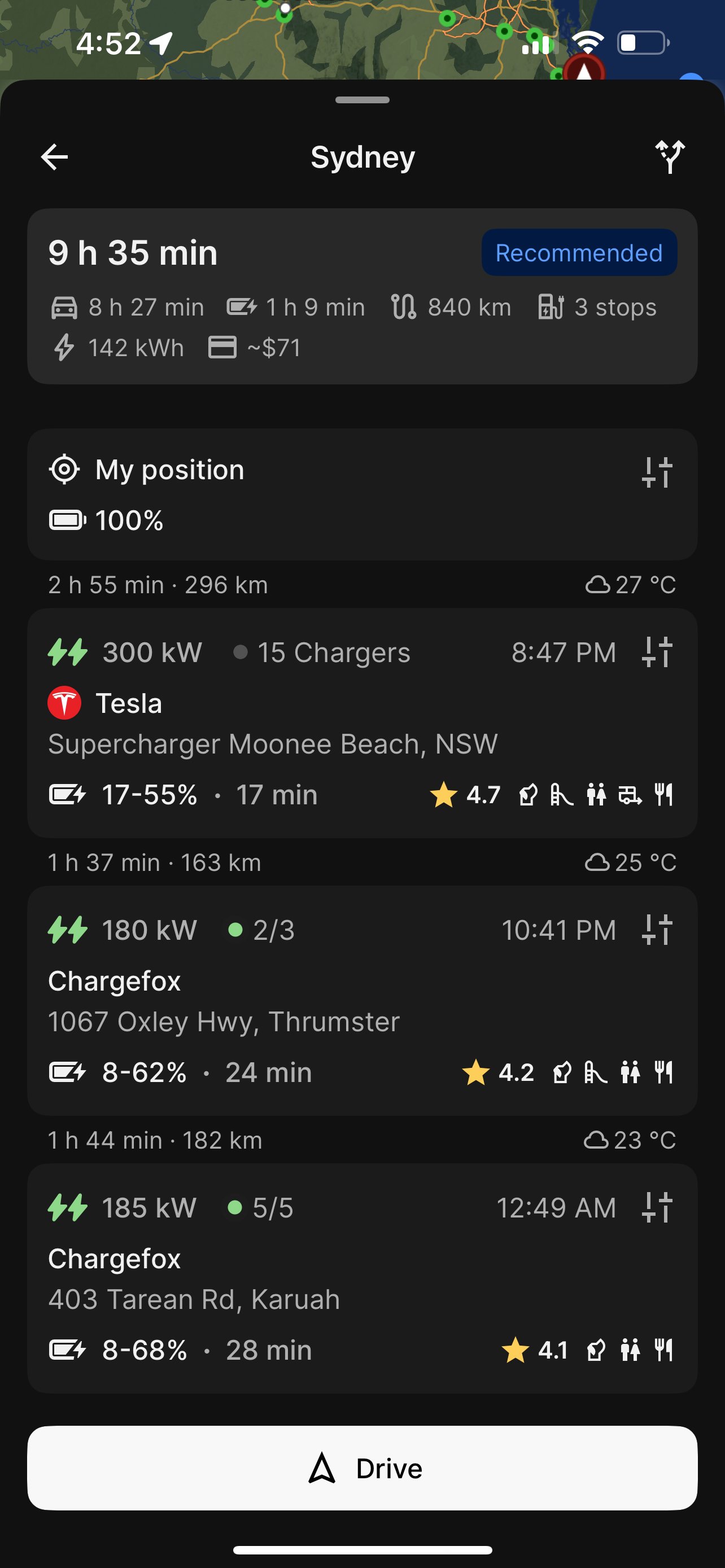
Susan didn’t just read about EV road trips — Susan tested them:
Gold Coast → Sydney → Canberra→ South Coast NSW→ Melbourne→ Great Ocean Road
She now confidently tells others how to plan EV travel:
Susan uses the A Better Route Planner (ABRP) and PlugShare phone apps to plan charging stops before leaving, so there’s no guesswork on the road.
She also uses a vehicle data dongle so planning apps can utilise real time battery SOC & energy use of her car to more accurately plan the trip. Though this isn’t required as ABRP is pretty close to the mark.
The ABRP app works out where you should stop to charge, for how long and what facilities are nearby e.g. toilets, food outlets etc. On the road, ABRP provides real time availability of the charger & the ability to find a nearby charger if need.
From Curiosity to Confidence
“I wanted to speak from experience, not just repeat what I’d read.”
As someone who had been advocating for EVs for years, Susan wanted firsthand experience before encouraging others to switch.
After multiple long trips, she says:
Range anxiety disappears with basic planning
Charging networks on major routes are already good
The reality is less stressful than people expect
Susan now talks about EV road trips with confidence because she’s done them herself — solo.
Two EVs, No Petrol Backup
“If we need something different, we just rent it.”
Susan’s household now runs:
BYD Dolphin (personal car)
BYD Atto 3 (partner’s work car)
They decided not to keep a petrol car “just in case”. For their annual 4WD K’gari/Fraser trip or if the occasion occurs where charging infrastructure isn’t there, they simply hire one. The money saved on fuel and maintenance covers the rental cost.
The Cost Reality
“The economics stacked up – especially with the commute.”
Her partner’s daily commute from the Gold Coast to Rocklea (over 160 km per day) made fuel costs painful in a petrol car.
With an EV:
Running costs dropped dramatically - fuel to energy costs are a third for the Atto3, compared to the XTrail he drove previously.
Home charging covered most driving
Public chargers have only been needed on road trips.
Much lower maintenance costs, with BYD requiring scheduled maintenance every 20,000 km, which costs about $150-$200 each time.
She also notes that EV pricing has continued to drop since she bought her Dolphin, making entry-level EVs even more accessible today. The BYD Atto 1 is priced at about $25,000, making the economics even more convincing.
The Bigger Picture: Why Susan Encourages Others to Switch
“People think EVs are harder than they actually are.”
Her advice to people considering an EV:
Try hiring one for a few days
Do your normal routine
Take one longer trip
Utilise a fast charger
See how it fits your life
She says most concerns disappear once people experience how normal EV ownership actually feels.
Practical Tips from a Real Owner
Phone apps to download:
ABRP (A Better Route Planner)
PlugShare
Charging habits:
Plug in whenever you’re home
Don’t wait until the battery is low
Plan longer trips in advance though with ABRP it’s just entering the locations like with any map app & let it do the work
Treat your EV as you do your phone - charge when you can
Mindset shift:
EVs aren’t about never stopping - you are going to need ‘bio-breaks’ to go to the toilet or eat anyway
On long journeys you are adding small amounts of charge along the way. You aren’t waiting until the battery is nearly empty and then charging it back to 100%
Time saved charging at home is slightly negated by the additional time charging on a road trip
Would Susan Go Back to Petrol?
Short answer: No.
Susan says the driving experience, running costs, and confidence gained from road tripping mean she wouldn’t return to petrol — and she’s glad she made the switch sooner rather than later.